
My early childhood was all about pony rides; the rest was all about horse trekking, and my adolescence was all about taking traditional riding lessons — as much as I loved going outside, my family had moved to Lebanon, where trail riding could mean stepping on a leftover landmine from the civil war so, alas, for a number of years I had to be content with riding within the confines of an arena.
Inevitably, I had a handful of school horses I grew fond of — Najim, Nessma, Genie, Corneil. And Yanna. Especially Yanna.
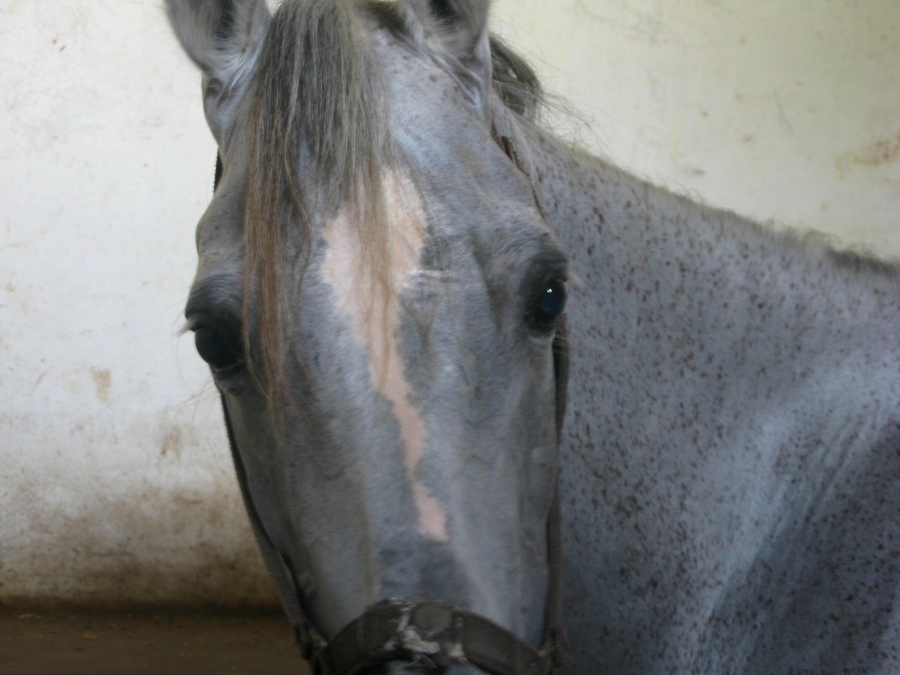
She was the favourite, my “heart horse”. She liked me too, I believe; she would call out whenever she heard my voice as I approached her box stall, and I could always expect to find her looking in the direction from which I would appear, ears pricked. I loved spending time with her; I once pressed my face against her mane as I cried, exhausted from the turbulence of my parents’ troubled marriage. In hindsight, she was the one from whom I learnt that spending time with a horse was as meaningful as riding — if not more so.

Yet, teenage me thought nothing really wrong with the photo above. It didn’t cross my mind that Yanna was opening her mouth because she’s uncomfortable from the bit; nor did I think much about the Gogue she was always ridden with, for it was just part of her tack to me. While most of the photos taken of me riding her are with her head on or in front of the vertical, there are also quite a few in which her head is behind it.
Yanna was a perfect example of the effects of domestication: animals that are tolerant of our inconsistencies. I look back at that time and feel nothing but sorrow for having hurt her, though I never meant it nor realized I was causing her any pain. I just didn’t know.
. . .
While the 2024 Olympics were underway, my heart sank when I saw the photos below. They represent a scene that’s all too common in equestrianism — human rapture at the expense of those whose distress falls on deaf ears.
I was reminded of the Fédération Équestre International (FEI)’s #TwoHearts campaign ahead of the 2016 Olympic Games, which coincided with the problem of tight nosebands. Before that, there was the “happy athlete” campaign, which was tainted by the controversy surrounding the rollkur training method (also known as hyperflexion). All these years and all those PR campaigns later, and riders have still largely gotten away with both. The latest is A Bond Like No Other, another attempt by the FEI to sweep all of the aforementioned issues under the rug through emotive audio and visuals complete with kitsch sentimentality. Seeing the hashtag in that British Equestrian’s Facebook post — the horse showing tense eyes, mouth straining against the flash noseband — felt grotesquely ironic.
It’s not just unfortunate “moments in time” — equestrian media is replete with images of horses showing discomfort, so much so one can effortlessly find them on Getty Images (such as this one), and posted by the FEI itself.
Nor is it limited to photography. Monuments showing horses with overbent necks, alarmed postures and gaping mouths are seen in plazas all over the world. In art — be it painting, sculpture, or film — distressed horses are omnipresent, even in the work of artists I like and admire.

As art reflects the human experience, it has documented the rift that has long existed between humans and horses — their need to escape unpleasantnesses clashing with our need to keep things under control. Photographer Crispin Parellius Johannesen has described it as a “history of violence”; once you see it, it is impossible to unsee.
No wonder my younger self thought nothing wrong with any of this — I, like the majority of people involved with horses (and not), was suffering from what’s been called bit blindness. We’re afflicted by it from childhood — it’s enough to think of what carrousel and rocking horses tend to look like.

I won’t say much about the scandal surrounding Charlotte Dujardin, for I believe everything that could be said has been said; but what cannot be overstated is that what she’s done is merely the symptom of a problem — watching the footage, I was upset, but not surprised. I’ve seen such things with my own eyes. Wielding whips and smacking horses with them — hard, because apparently a horse “doesn’t feel” a little tap — is the norm and is encouraged, in the name of showing the horse “who’s in charge”. Blaming the horse for “misbehaviour” — with no regard or curiosity as to what is causing it besides the assumption of laziness or “trying it on” — is also the norm. Children are trained in the fine art of it the moment they are handed a whip.
. . .
These last Olympic equestrian events were nothing short of unwatchable for me — from a rider who was eliminated due to his horse bleeding from the mouth, to dressage horses showing ischemia of the tongue (including the horse of a gold medal winner). All this when the FEI and the International Olympic Committe were served a list of actionable recommendations to safeguard the wellbeing of horses, yet mostly did not adopt them. Why?
And it’s only been getting worse.
Too many equestrians — and much of the equestrian media — still have their heads in the sand. You might be the most qualified expert in animal welfare and equine sciences, but apparently one can only criticize the treatment of horses involved in sport if you’re among the ranks of those at the top. Concerns get deflected, incidences downplayed.
But whenever I feel frustrated about all this, I think of Yanna — because of my own journey in the horse and equestrian worlds, I have had to come to terms with the fact that as much as I loved her, I hurt her sometimes. It is a pill that’s hard to swallow, even if my actions were unintentional — the only thing I can do is forgive myself. In other words — I’m not surprised so many people involved with horses prefer to deny what is in plain sight. While there is a feeling of empowerment that comes with taking responsibility for one’s actions, the way to get there undeniably causes a hell lot of discomfort. And shame.
 YASMINE SAAD -- ARTIST